
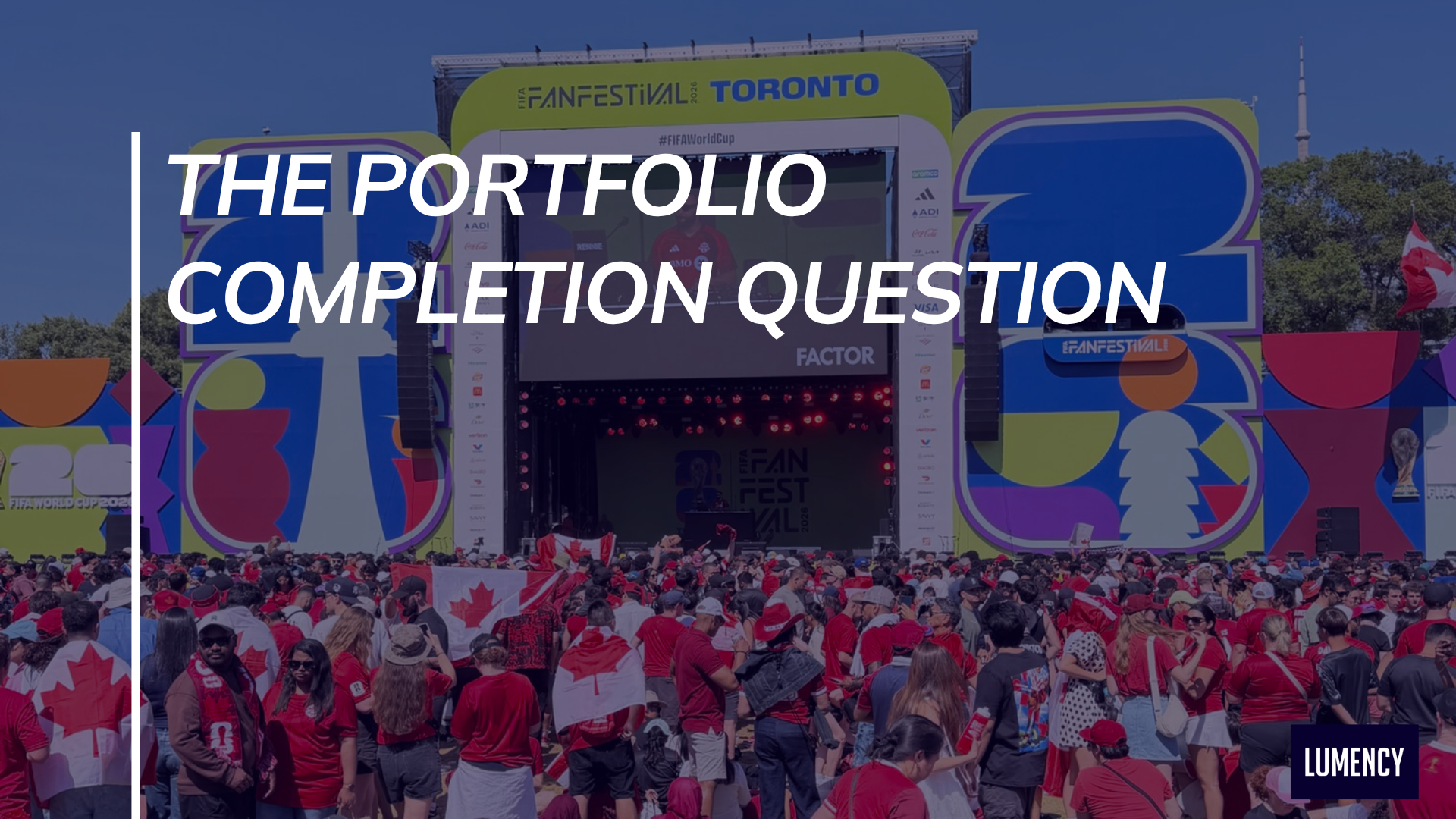
Sport earns its place in sponsorship portfolios. It delivers scale that few platforms can match, creates shared cultural moments with genuine emotional weight, and reaches audiences that are already deeply engaged. Roughly 70% of global sponsorship rights fee investment sits in sport, and that reflects something real, not inertia.
This is not an argument against sport. It is an argument for understanding its limits.
Because while sport excels at creating certain kinds of brand relationships, it cannot create every kind. And recognising that distinction is one of the hallmarks of a mature sponsorship portfolio.
The emotional context matters
Whether in a stadium, at a watch party, or following from home, sport connects brands with people in a very particular emotional state. Fans are tribal, competitive, and emotionally invested. They are experiencing the highs and lows of competition, often alongside a wider community of supporters. It is one of sponsorship’s most powerful environments.
But it is only one emotional context.
Sport itself is also an expression of identity. Supporting a team, following an athlete, or belonging to a fan community says something about who we are and where we belong. But it does not express every dimension of identity, nor does it place people in every emotional context in which brands can become relevant.
The same person who watches sport also attends concerts, visits galleries, follows artists, participates in local festivals, and engages with cultural communities that express a very different part of who they are.
The distinction is important.
Those are different emotional contexts, and they create different opportunities for brands to build relationships with the same audience.
At a music festival or arts event, participation often reflects taste, creativity, curiosity and personal values, even while remaining a shared experience. Those dimensions move to the foreground in ways that competitive sport rarely demands. The emotional experience is no less meaningful, but it is fundamentally different.
That difference changes the role a sponsorship can play.
Brands aren’t simply entering different platforms. They’re entering different emotional contexts.
It is often the same audience
It is tempting to think about cultural sponsorships as a way to reach different audiences.
Sometimes they are.
More often, they are another opportunity to reach the same people in a different emotional context.
That changes the strategic question.
A brand investing in both a major sports property and a music platform is not necessarily diversifying its audience. It may instead be broadening the emotional relationship it builds with the audience it already has.
That distinction matters because audiences are rarely one-dimensional.
People don’t experience life through a single passion point. They move between communities, interests, identities, and emotional states. Sponsorship portfolios should recognise that complexity rather than assuming one platform can carry the entire relationship.
There is another important consideration.
Reaching the same audience multiple times is not automatically additive. Fan duplication is real and belongs in portfolio planning. The objective is not simply to appear across more properties. It is to ensure that every investment contributes something distinct to the relationship, rather than repeating the same message in a different venue.
The same discipline applies
Most sponsorship portfolios already contain cultural investments.
Music. Arts. Community festivals. Museums. Public events.
The question is no longer whether those platforms belong in the portfolio.
The question is whether they have a clearly defined role.
As sponsorship portfolios become more deliberately managed, every property should exist for a reason. Sport requires that discipline. Cultural platforms deserve exactly the same level of rigour, even if the outcomes they produce differ.
This is where many brand owners lose discipline.
Cultural properties often generate stronger personal advocacy inside organisations than sports properties. Senior leaders may have genuine affinity for a particular arts institution or music event, and that enthusiasm can accelerate investment ahead of disciplined evaluation.
There is nothing wrong with passion.
But passion for a property is not the same as a defined role within a sponsorship portfolio.
The same questions should apply regardless of category.
What role does this property play?
Who does it reach?
In what emotional context?
Toward which business objective?
How will success be measured?
Does the organisation have the activation capability to realise its potential?
Those questions should be as routine for an arts partnership as they are for a league sponsorship.
Building more complete portfolios
The strongest sponsorship portfolios are not collections of good properties.
They are systems in which every investment performs a distinct strategic role.
Sport will often remain the foundation. Its scale, cultural relevance, and ability to create shared moments are unmatched.
But a foundation is only one part of the structure.
Understanding where sport excels, and where it reaches its limits, is what allows brand owners to build more complete sponsorship portfolios. They recognise that sponsorship is not simply about reaching audiences. It is about reaching people in different moments, different emotional contexts, and different expressions of who they are.
The result is not a more diversified portfolio.
It is a more complete one.