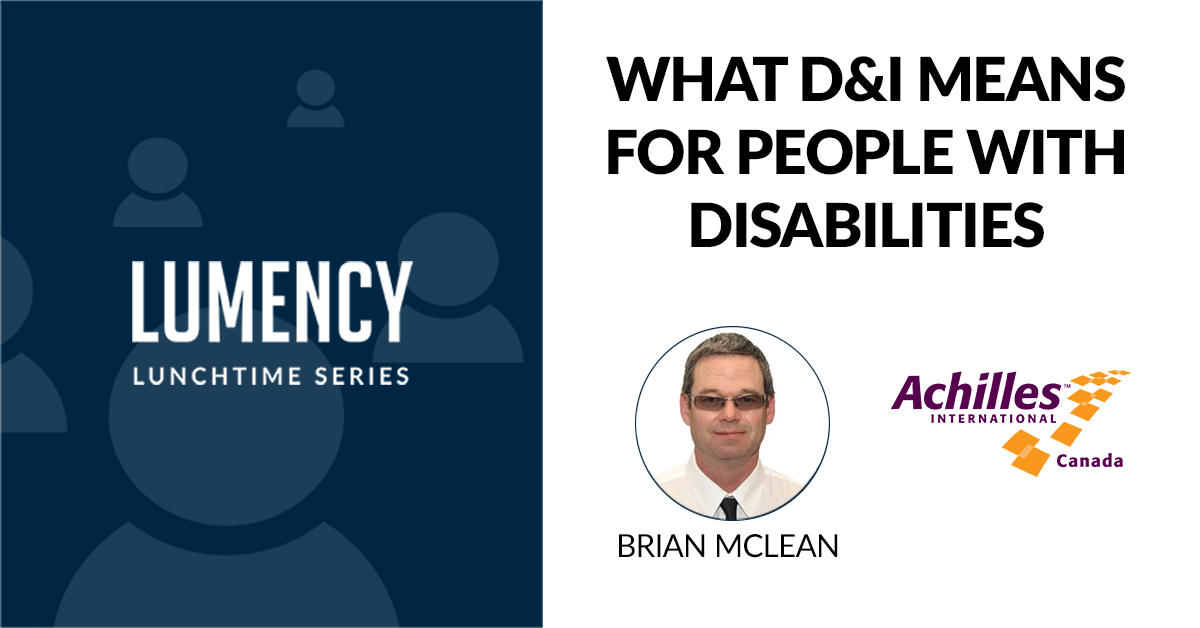
As part of Lumency’s ongoing commitment to holding conversations around diversity and inclusion, we had the pleasure of hosting Brian McLean, of Achilles Canada and the CNIB Foundation, for a Lumency Lunchtime Series focused on creating an inclusive environment for those with disabilities.
ABOUT BRIAN McLEAN
Brian McLean is the President of Achilles Canada and Program Lead for Partnerships, Recreation, and Sports at the CNIB Foundation. Brian became the President of the Canadian division of the non-profit organization, Achilles International in 1999, and since then has made it his mission to ensure that persons with disabilities can continue to live active and healthy lifestyles. One of Brian’s biggest responsibilities as President is overseeing the annual Achilles Canada St. Patrick’s Day Run, which is the largest 5k race in Canada that fully integrates able-bodied athletes and athletes with a disability.
In addition to his role with Achilles Canada, Brian also works as the Program Lead for Partnerships, Recreation and Sports at the CNIB Foundation. In this position, Brian focuses on providing employment opportunities for blind and visually impaired individuals.
Brian is both visually and hearing impaired, but has not let his disabilities slow him down, completing 11 marathons in his life (so far). Brian firmly believes in the power that an active lifestyle can have on one’s outlook on life and connection to the community.
IN THIS LUMENCY LUNCHTIME SERIES…
Brian shares his backstory, including how his disabilities have progressed over time, and the impact they’ve had on his life and career choices. He discusses Achilles Canada in-depth, including how it got started in Canada, the connection it has to Terry Fox, and the annual St. Patrick’s Day Run.
Finally, Brian discusses what can and should be done to increase the understanding and inclusion of persons with disabilities in society, including common societal misconceptions and how employers should focus their hiring efforts to ensure they are being inclusive in their selection.
A few quick highlights and takeaways:
- When dealing with individuals with a disability, the most important thing is to ask a question and be comfortable with not knowing, rather than worrying about what to say or shying away from contact.
- In hiring practices, the most important thing is for interviewers to keep an open mind and give everyone an honest opportunity. There is a huge number of highly qualified persons with disabilities who can add their own very valuable perspectives.
- Working as the President of Achilles Canada, the annual St. Patrick’s Day is the largest 5k race in Canada that fully integrates able-bodied athletes and athletes with a disability, with the goal of having a 50/50 split of able-bodied athletes to athletes with a disability.
SEE BELOW FOR A MORE FULSOME RECAP OF THE CONVERSATION
On Brian’s disabilities and outlook…
- Brian openly shared that he is both hearing and visually impaired and is considered legally blind. Initially wearing a hearing aid in one ear, he slowly lost hearing in both ears and currently has two hearing aids.
- Brian has a degenerative condition called Retinitis Pigmentosa that affects both eyes, which starts out as trouble seeing at night and can ultimately lead to permanent loss of vision. He first noticed his condition while playing hockey as a teen, having difficulty tracking the puck (though he still loves to play the game!).
On Achilles Canada….
- Achilles International is a not-for-profit organization with headquarters in New York City. The organization was founded by Dick Traum, an amputee runner who ran the NYC marathon. The Canadian division of the organization was founded in 1999 and has been instrumental in ensuring a healthy and active lifestyle for those with disabilities. The focus of the organization is running, with all profits going towards the athletes and ensuring they have the equipment and ability to run and stay active.
On Achilles International’s connection to Terry Fox…
- Terry Fox’s brother Darryl showed an article on Achilles International’s founder, Dick Traum, to Terry, which helped spur inspiration for The Marathon for Hope. Following the Marathon for Hope and Terry Fox’s passing, the Achilles International organization opened operations in Canada and has helped support the annual Terry Fox Run.
On the St. Patrick’s Day Run…
- At one point the largest 5k run in Canada, the annual St. Patrick’s Day Run just celebrated its 21st anniversary. While it started as a 5k, it now includes a 1k and a 10k. The run is currently the largest 5k race in Canada that fully integrates able-bodied athletes and athletes with a disability. The goal of the event is to showcase the athletes and raise awareness for the disabled athletes, with the dream to one day have a 50/50 split of able-bodied athletes to athletes with a disability amongst runners (currently around 75/25 able-bodied).
- Unfortunately due to COVID-19, the 2020 edition was forced to cancel its live portion just days before the race was to be held, but the organization was able to put together a virtual element for those to compete and participate from afar. The run is always on the lookout for additional sponsors and would be open to holding conversations with new potential partners.
On biases, diversity and inclusion for people with disabilities…
- Efforts to support diversity and inclusivity for persons with disabilities have been greatly improving over the years—something Brian has noticed particularly over the last five to 10 years—and in general society is more receptive to change and ready to listen, but more intentional action is still needed.
- The biggest thing is that people should not be afraid to ask a question of someone with a disability, rather than worrying about what to say or refusing to acknowledge it. Personal experience has shown that people often look the other way, as people are sometimes afraid of what to say, or how to act around someone with a disability. Rather, it is best to simply ask questions and treat them just like everyone else. Make everyone feel like part of the team, make everyone feel included.
- People with disabilities also know their own bodies and their own limits very well. To that end, they will be honest about when they may need assistance. For example, if as an able-bodied person you see someone with a disability having difficulty crossing the street, do not be afraid to approach them and say, “Hey, I noticed you having difficulty, can I help you?” They will be transparent with you on whether or not they need assistance and will appreciate your asking.
- For employers, it is of the utmost importance to keep an open mind and give people an honest opportunity (not a handout, but a fair shot). With many jobs, only very small modifications to one’s work environment (i.e. a computer, a phone, a communication style, etc.) may be needed to accommodate someone’s disability and enable them to perform the job function at a high capacity. Just like a sport, a job can be accommodated for a person with a disability. And, do not discount the valuable perspective that someone with a disability can bring to an organization.
On the best career advice he’s received…
- “Never take ‘no’ for what it is. Never take it as a solid answer. Instead of giving up once you hear the word ‘no,’ treat it as a ‘not today.’ Or, in the context of making a deal or beginning a new partnership, think of it as a ‘something’s missing.’ Then, use that as motivation to broaden your mind, go back through your notes to find the missing link or something you may have overlooked, make adjustments, and make the deal happen!“
We thank Brian for joining us and leading a great discussion. It was great to hear about his professional experience and his personal experience living with disabilities, and we value and respect the contributions he has personally made toward making the world a better place!
Looking at this through the lens of our values of transparency, ownership, credibility, and kaizen (continuous improvement), conversations like these help us continue to address and overcome our biases, expand our perspective and broaden our minds.
As Ian and Brian discussed, it is important to keep having these conversations as an avenue to bring real change in society.
Feel free to contact Brian at [email protected]
By: John Hughes