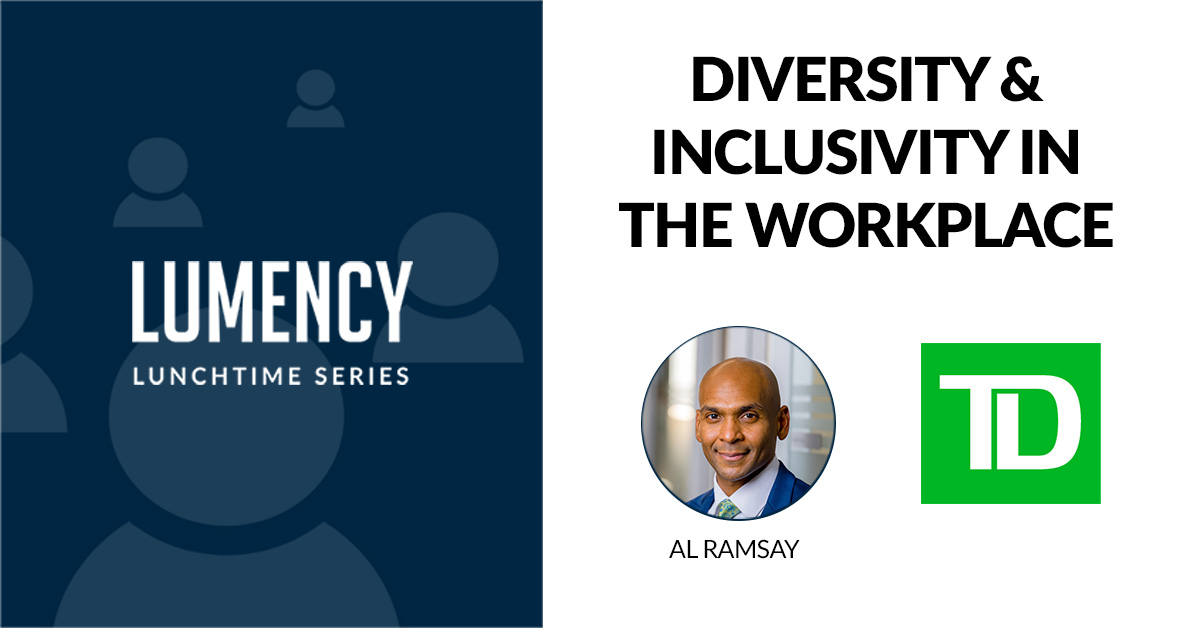
As part of Lumency’s Pride Month celebrations, we had the pleasure of hosting Al Ramsay from TD Wealth for a Lumency Lunchtime Series focused on diversity and inclusivity in the workplace.
ABOUT AL RAMSAY
Al is a member of the TD Wealth leadership team, acting as a key liaison between TD Wealth Advice and Business Banking. He also leads TD’s LGBTQ2+ business development team executing strategies across One TD.
Al has a passion for advancing inclusiveness in the workplace and in his community. He has held increasingly senior positions supporting TD’s Diversity & Inclusion mandate and has been instrumental in helping TD to become a leader in the Black and LGBTQ2+ communities. Al has spearheaded customer, employee, and community initiatives such as the launch of several of TD’s Employee Resource Groups, including its LGBTQ2+ and Black Employee Networks, which have now expanded to include thousands of TD employees across North America.
IN THIS LUMENCY LUNCHTIME SERIES…
In this session, Al and Ian Malcolm (Lumency’s President & CEO), discuss what leaders and brands are doing and should be doing as they focus on improving diversity and inclusivity in the workplace. Al provides input on how brands can reconcile downfalls and shares tactics on how to better improve workplace culture, hiring processes and personal growth—through his own personal experiences and stories.
We learn about racism and LGBTQ2+, their associated biases and how to address these issues through bold statements, honest conversations, and positive leadership. Al focuses on the importance of togetherness and openness to effectively promote inclusion and reduce the impact of deep routed prejudices within the black and LGBTQ communities.
A few quick highlights and takeaways:
- Brands are highly influential, and their messaging needs to be bold. Brands and leaders will need to make strong statements against racism (and follow them up with action) if they want to remain relevant and hang onto their fans and consumers.
- Brands can say the right thing, but when we look at what is hidden behind closed doors, we see a gap. With progressive conversations and the support of diversity and inclusivity in a workplace, we can inspire clients, employers, and co-workers.
- Terms we used to be afraid of are becoming the theme of more meaningful conversations today. Addressing and placing value on the words ‘black’, ‘white’ and ‘privilege’ will shift the way people think about racism as a whole.
SEE BELOW FOR A MORE FULSOME RECAP OF THE CONVERSATION
On reconciling the ‘saying vs. doing’ gap…
- It’s about action. We have been making progress around defining and understanding diversity, but need to make the shift to more inclusion. Beyond strong leadership and making bold statements, organizations need to back up their statements and goals with actionable policies and procedures, and measurable outcomes..
On brands that are making progress…
- Many of the banks and financial institutions across Canada and North America as a whole—including TD of course—have been doing a wonderful job of standing up, supporting their employees, and starting from within.
- Nike has made their stance known for quite some time, and recently doubled down by launching another campaign that puts more support behind Colin Kaepernick and the cause. The Jordan Brand has also donated $100 million to support grassroots initiatives and deserve a kudos for not just saying it but doing it.
- While Starbucks occasionally receives some criticism around their initiatives and messaging, they have been creative in terms of training and sharing stories in support of diversity and inclusivity. Overall, they have demonstrated that they are willing to make mistakes and learn along the journey—an important characteristic.
On meritocracy and the ‘best person for the job’…
- While some organizations claim to always pick the ‘best person for the job,’ focusing on more technical boxes such as education and experience, it cannot be denied that the ‘softer’ attributes such as one’s culture and personal background factor heavily into hiring decisions. And of course, when it comes to these attributes, everyone has biases. To overcome these biases, it is crucial to implement checks and balances. For example, instead of making a hiring decision by yourself, one solution is to bring in a diverse panel of colleagues to discuss the candidate’s qualifications and potential fit. This can help ensure decisions around hires and promotions are truly unbiased.
On the evolution of terminology and conversations around diversity and inclusion…
- About 15 years ago, people used to be afraid to say ‘black’ or ‘white’ or ‘queer.’ The word ‘racism’ was a lightning rod, even in Canada. More recently, we have been moving the conversation about race and culture forward, with more focus on discussing anti-racism and being anti-racist versus accusing individuals of being racists. That is, instead of pointing fingers at people, when you see something racist in action, do you call it out so it can be fixed? We want people to be bold in being anti-racist, and love that this is where the conversation is going.
- ‘Privilege’ is another term that was not discussed but, now, we are finally having these conversations. We are addressing terms like ‘privilege’ in such a way that no one is shaming anyone, but seeking to understand the access and power that may come with the colour of your skin or your status.
On the best way to call someone out for a non-inclusive action or statement…
- At TD, we encourage people to challenge each other. If someone does or says something inappropriate—for example, ‘You throw like a girl.’—we like to stop and say, “Ouch…”. What this does is expresses hurt in a non-confrontational manner and forces people to pause, giving an opportunity for all parties to unpack what was said.
On the best advice you’ve received…
- “Never lose yourself or your authenticity.” What this means is, start with yourself. Speaking as a gay person, sometimes we create different versions of ourselves for the sake of protection, then we spend our adult lives searching for the most authentic versions of ourselves. The sooner you heighten your sense of who you are, the sooner you can bring greater good to yourself and society and be a stronger agent of change.
- As you progress in your career, “Never forget what got you here.” This ties back to being your authentic self, living your full identity. Whether it’s your creativity or your can-do attitude, don’t change key aspects of who you are because you feel like you need to. Always stay true to yourself, in business and in life.
As Al and Ian discussed, now is the time for in-depth conversations to be had, and we want to thank Al again for joining us and sharing his time, story and perspective.
We place major emphasis on our values of transparency, ownership, credibility, and kaizen (continuous improvement). Conversations like these are often the first step toward developing a deeper understanding of each other, owning up to our biases and overcoming them, and improving who we are as people.
The more we come together and the more we work together, the more we can affect changes that need to be made.
Please feel free to reach out to Al at [email protected]
By: Kirby Zdrill