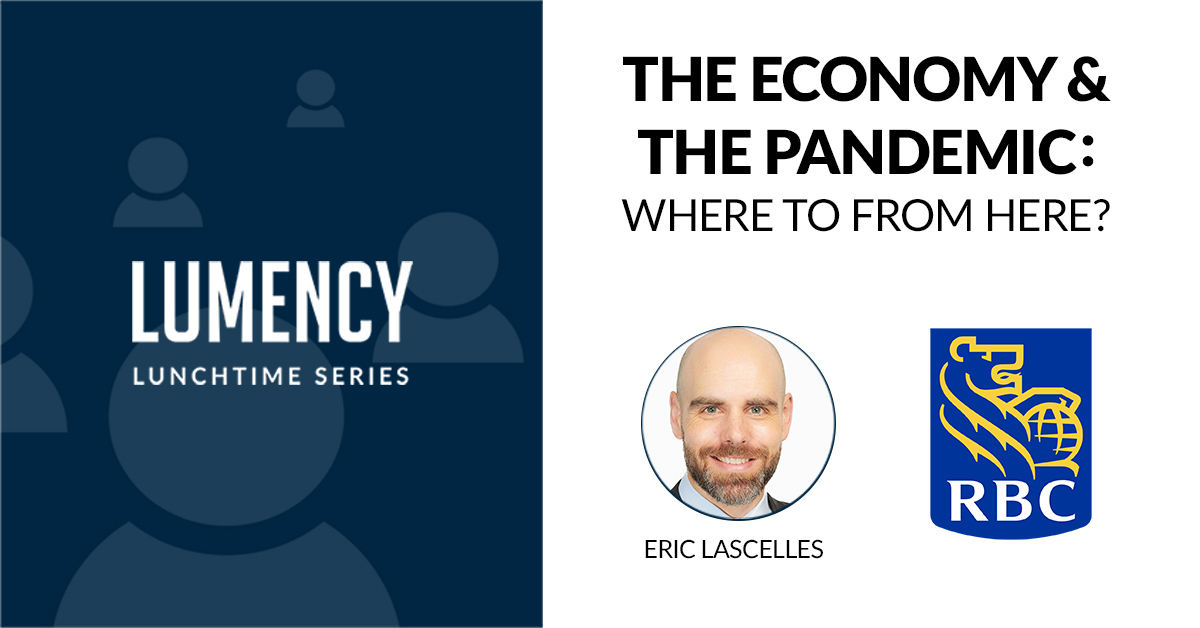
As we continue to navigate the COVID-19 pandemic, we had the pleasure of hosting Eric Lascelles from RBC Global Asset Management for a Lumency Lunchtime Series focused on the outlook for the Canadian economy in the short and long term.
ABOUT ERIC LASCELLES
Eric is the Chief Economist for RBC Global Asset Management Inc. (RBC GAM). He maintains the firm’s global economic forecast and advises its portfolio managers on key themes and risks. Eric is also a member of the RBC Investment Strategy Committee (RISC), which is responsible for the firm’s global asset mix recommendations.
Eric makes regular presentations both within and outside of RBC GAM. He is also a frequent media commentator on global economic and financial trends, appearing regularly on CNBC, BNN, and other networks. Eric’s written editorials have appeared in The Globe and Mail, National Post, The Wall Street Journal, and Financial Times.
Externally, he serves on the C.D. Howe Institute’s Business Cycle Council—the group that dates recessions and other economic turning points in Canada—and is also on the board of the Toronto Association of Business and Economics.
IN THIS LUMENCY LUNCHTIME SERIES…
Eric shares RBC’s latest outlook on the Canadian economy, and how it is expected to impact consumer behavior. He touches on how different economies across the globe have been affected, how long we can expect the recovery of the Canadian economy to take, as well as how Canada’s proximity to the U.S. could impact economic recovery.
Eric also talks about how individual consumer spending has been impacted, when we can expect spending to return to normal, and the future of the government programs that have been put in place to boost the economy.
A few quick highlights and takeaways:
- Internationally, the severity of the impact of COVID-19 on economies is largely dictated by the degree to which they implemented shutdowns. That said, while those with looser restrictions were not impacted as heavily, they are more susceptible to a second wave and resulting dip.
- The economy is recovering more quickly than expected, but it will still take time before it recovers completely, and we return to our previous GDP trajectory. This is due to multiple factors; the design of government responses in lifting restrictions in incremental stages rather than all at once, the reduced level of demand due to reduced income and generalized risk aversion around things like social activities, and shocks to the supply chain.
- Online shopping has roughly doubled since the start of the crisis. Furthermore, and partially due to this, large stores generally win while small stores generally lose. This is due in part to greater e-commerce offerings, but also because people want a one-stop-shop when visiting physical stores.
- Consumer spending decreased when the pandemic hit, and while still at decreased levels, we are seeing an increase in spending habits as restrictions begin to lift and people are moving around more. Interestingly, savings rates have seen an uptick despite many people, unfortunately, losing their jobs—this is likely due to the fact that, in aggregate, people have been spending less and simultaneously government stimulus has been enormous.
- When it comes to long-term implications of a crisis like this, events like the Spanish Flu tell us that many consequences will turn out to be temporary as opposed to permanent. That being said, some expected implications include: a higher emphasis on the value of human life and increased sensitivity to low probability/high impact risks such as future viral outbreaks; a trickier geopolitical landscape in the form of anti-globalization and a potential increase in populism, higher public debt levels, lower interest rates, plus any number of changes to daily life including an increase in remote work and decrease in travel and consumers eating out.
CLICK HERE FOR THE FULL PRESENTATION
A massive thank you to Eric for joining us and sharing this comprehensive outlook, outlining the major themes in economic recovery, business trends, and evolving consumer habits and sentiments in the Canadian market and beyond.
As we move through this crisis, we are certain these insights and predictions will prove helpful to many businesses, ours as well as those of our clients and partners.
For more information surrounding this economic outlook, please reach out to Eric at [email protected]
By: Kirby Zdrill